
Smartphones cost more without always getting better. Buyers are paying the AI boom’s bill
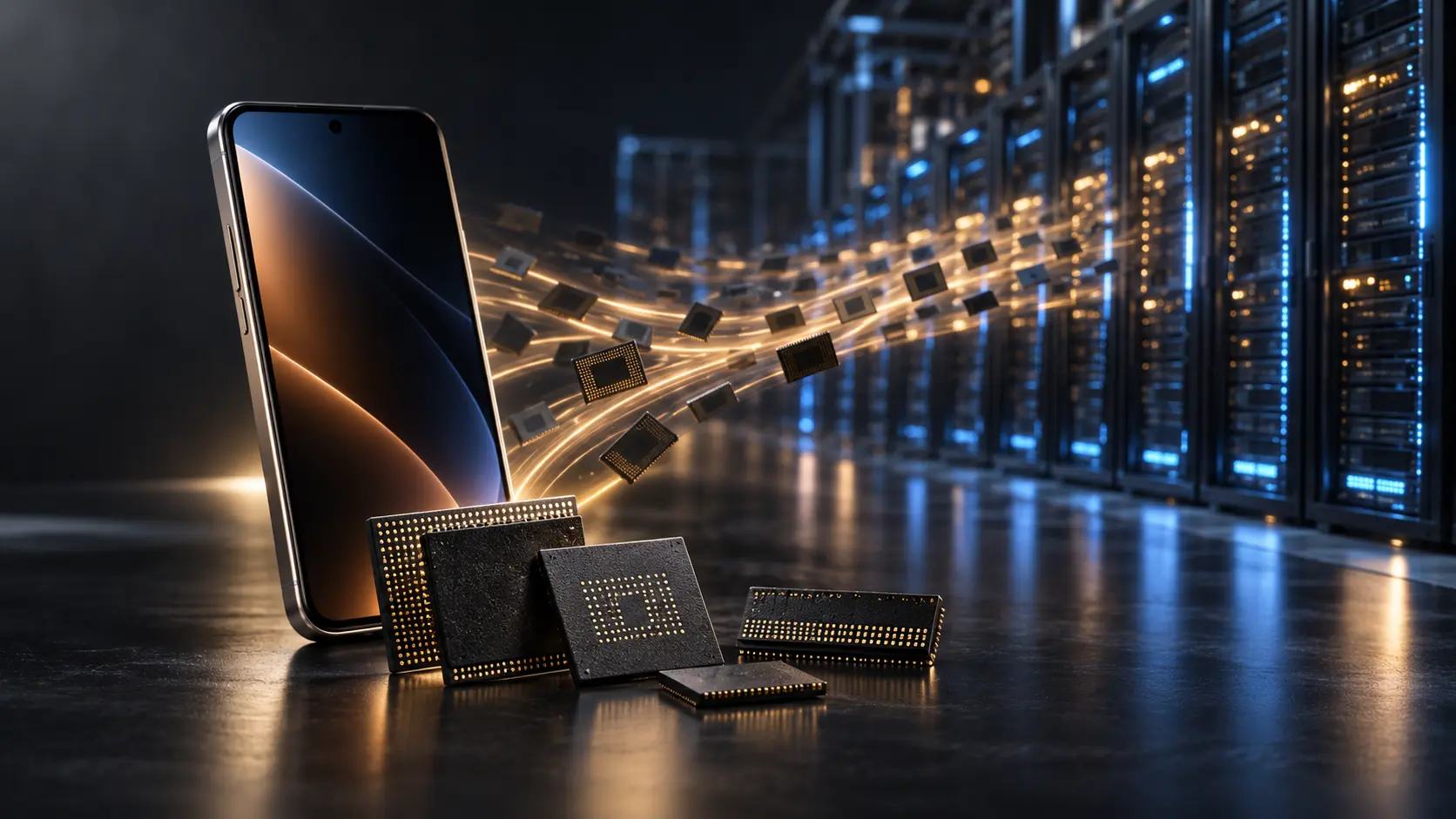
Smartphones are getting more expensive mainly because manufacturers pay far more for DRAM and NAND memory while AI infrastructure absorbs a growing share of global supply. That does not mean every handset will rise by the same percentage, but pressure is strongest in budget and mid-range devices.
According to the latest forecasts, global smartphone sales will fall by 16.7 per cent in 2026, whilst the average selling price will rise by 27.6 per cent to $581. Although fewer units will be sold, the total market value is expected to increase by 6.3 per cent to $613 billion.
This is not a simple instruction to buy immediately. We explain where the increase comes from, which parts of the market are most exposed and when buying now makes sense—or when waiting for a particular launch or discount is wiser.
| Metric | IDC 2026 forecast |
|---|---|
| Worldwide shipments | −16,7% |
| Average selling price | 581 USD (+27,6%) |
| Total market value | 613 mld USD (+6,3%) |
| Android shipments | −24,3% |
- How much are smartphone prices expected to rise in 2026?
- Why does the AI boom raise the cost of phone memory?
- Which phones will feel the crisis most?
- Does a higher price mean a better phone?
- Should you buy a smartphone now or wait?
- How should you choose a phone during the memory crisis?
- What does a global forecast mean for local prices?
- The smartphone memory crisis — key conclusions
- FAQ — why are smartphones getting more expensive?
How much are smartphone prices expected to rise in 2026?
The $581 figure is not the price of a typical phone in every shop. It is a global ASP: the value of all devices sold divided by unit volume. It rises both because individual prices increase and because the cheapest handsets disappear from the mix.
IDC says 173 million sub-$100 smartphones shipped last year. In Q2 2026 that segment contracted by almost 60% year on year. Removing large numbers of cheap phones pushes the average higher even if one flagship keeps the same ticket price.
Why does the AI boom raise the cost of phone memory?
Phones use DRAM to run apps and NAND to store software, photos and files. Memory manufacturers also supply data centres ordering huge volumes of more profitable AI-server products. New production lines take time, so supply cannot respond instantly.
IDC estimates DRAM and NAND costs are more than 300% higher year on year and may remain under pressure until at least 2028. Buyers do not see this expense as a better camera or battery: a brand must charge more, reduce memory or save on another component.
Which phones will feel the crisis most?
Low-cost Android phones face the greatest risk because margins are thin and memory is a large part of the bill of materials. A manufacturer may remove an 8/256GB option, replace it with 6/128GB, raise the price or stop making a model that no longer pays.
IDC forecasts Android shipments down 24.3%, compared with a 1.3% fall for iOS. That does not make iPhones immune. Apple and Samsung have scale, purchasing power and more customers using finance, so they are better placed to pass costs through.
Does a higher price mean a better phone?
Not always. In a normal upgrade cycle, a higher price may buy a better screen, camera or processor. During a component crunch, part of the increase only covers hardware that used to cost less. A phone can therefore be dearer with a very similar specification.
Compare more than launch prices: check RAM and storage, software support, battery, repairability and the real improvement over your current device. Our iPhone 18 Pro teardown analysis shows how hidden design choices can affect long-term value.
Should you buy a smartphone now or wait?
Buying now is reasonable if your phone is damaged, losing support or the right model is available within budget. Especially at the affordable end, waiting for the crisis to end does not guarantee a saving because brands may cut those devices rather than restore old prices.
Wait if your current phone works well and the planned upgrade is minor. But wait for a specific reason: a chosen launch, battery tests, a previous-generation discount or an operator offer. Do not assume the whole market will become cheaper within a few months.
How should you choose a phone during the memory crisis?
Set a minimum configuration first. For someone storing photos and video, paying for 256GB may be more sensible than replacing the device early. Do not pay for unused capacity merely because a larger option is presented as future-proof.
Compare a new phone with the discounted previous generation and a properly warranted refurbished device. Check support length, battery health and repair cost. Judge a promotion against the normal price over several weeks, not only a crossed-out number.
What does a global forecast mean for local prices?
Local prices also depend on exchange rates, taxes, distribution and existing inventory. A retailer may sell stock bought before the latest increase, so global pressure will not appear in every market or on every shelf at once.
The likelier result is fewer compelling entry models, more expensive high-storage variants and slower post-launch discounts. Track the exact handset you want instead of trying to predict one date when every smartphone becomes dearer or cheaper.
The smartphone memory crisis — key conclusions
- IDC forecasts shipments down 16.7% and the average price up to $581 in 2026.
- DRAM and NAND cost more because supply cannot keep pace with AI data-centre demand.
- Budget phones and good-value storage variants face the greatest pressure.
- Waiting does not guarantee a lower price; decide from your current phone and a specific offer.
- Exchange rates, tax, inventory and promotions alter the effect in each country.
FAQ — why are smartphones getting more expensive?
Will every smartphone become 27.6% more expensive?
No. That is the projected increase in the global average, affected by price rises and the disappearance of cheap models. An individual handset can move differently.
Which phone components are affected by the AI boom?
Primarily DRAM working memory and NAND storage. Consumer devices and fast-growing data-centre infrastructure compete for related manufacturing capacity.
Are phones with less memory better value?
Not necessarily. If 128GB fills quickly, replacing the phone early may cost more than a sensible upgrade to 256GB.
Will phones become cheaper again after 2027?
There is no guarantee. Forecasts expect years of pressure, and brands rarely reverse prices automatically when costs ease. They may add storage or features instead.
Is last year’s phone worth buying?
Yes, if it has long support, a healthy battery and a genuinely lower price. Compare storage and repair cost rather than judging only by the year in its name.
Related stories on the CRONG blog
This independent CRONG article is for information. Global forecasts do not guarantee a price change for any individual model or country.